

The check engine light on your Audi is one of those warning signals that drivers respond to very differently. Some pull over immediately, convinced the engine is about to fail. Others drive for months with the light on, reasoning that if the car still moves, it probably isn’t serious. The truth is almost always somewhere in between — and on an Audi, that ambiguity can be expensive if you read it wrong. Dieter’s Porsche & BMW Service on Hancock Street has been diagnosing European vehicles in San Diego for years, and Audi check engine light diagnostics are among the most common calls they receive. Here’s what the light actually means and what it takes to interpret it correctly.
What Triggers the Check Engine Light on an Audi
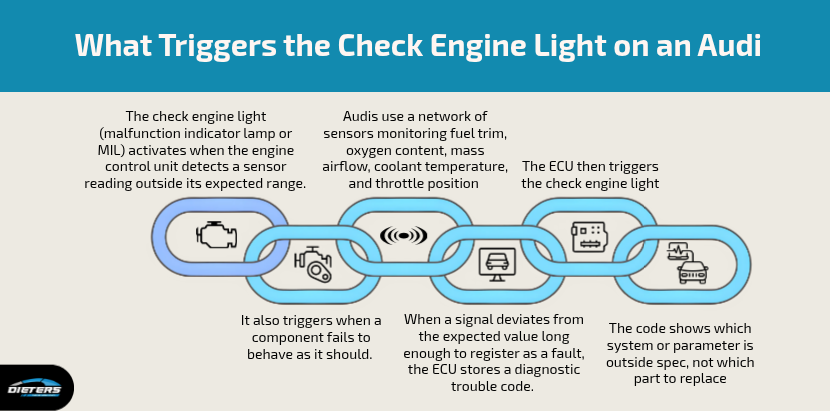
The check engine light — technically the malfunction indicator lamp, or MIL — activates whenever the engine control unit detects a sensor reading outside of its expected range or a component failing to behave as it should. Audis use a sophisticated network of sensors monitoring fuel trim, oxygen content in the exhaust, mass airflow, coolant temperature, throttle position, and dozens of other parameters. When any one of these signals deviates from the expected value long enough to register as a fault, the ECU stores a diagnostic trouble code and triggers the light. The code itself doesn’t tell you what part to replace — it tells you which system or parameter is outside spec. Correctly diagnosing what caused the code to set requires more than plugging in an OBD reader and replacing the first part that comes up.
Common Causes on Audi Models
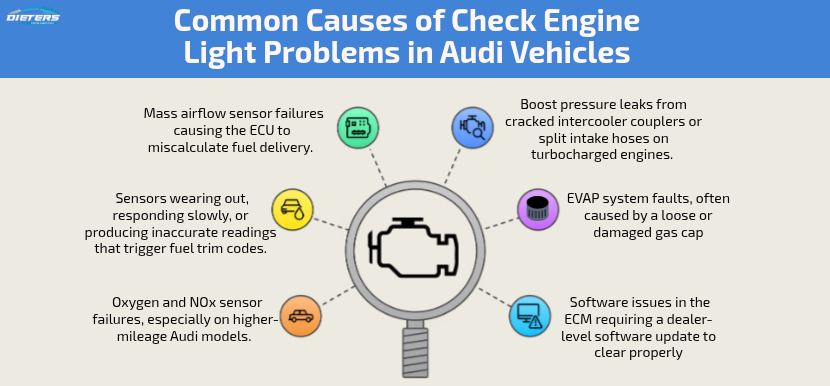
Several faults appear repeatedly across Audi’s lineup. Oxygen and NOx sensor failures are among the most common, particularly on higher-mileage cars — these sensors wear out, respond slowly, or produce inaccurate readings that trigger fuel trim codes. Mass airflow sensor failures cause the ECU to miscalculate fuel delivery, resulting in rough idle, hesitation under acceleration, and a lit check engine light. On Audi’s turbocharged engines, boost pressure leaks from cracked intercooler couplers or split intake hoses trigger lean codes that look like sensor failures until the actual leak is found. EVAP system faults — often caused by nothing more serious than a loose or damaged gas cap — are another frequent trigger that causes unnecessary concern. On newer Audis, software issues in the ECM can generate codes that don’t correspond to a physical failure at all and require a dealer-level software update to clear properly.
The Difference Between Solid and Flashing
Not all check engine lights carry the same urgency. A solid, steady check engine light indicates a fault that the ECU has logged but that isn’t causing immediate danger to the engine. The car can typically be driven for a reasonable period, but the fault should be diagnosed soon. A flashing or blinking check engine light is an entirely different situation — it indicates an active misfire severe enough to send unburned fuel into the catalytic converter, which can destroy it within a few miles of driving. A flashing check engine light should be treated as a stop-driving signal. Getting an Audi owner to understand this distinction is one of the most important parts of what Dieter’s technicians communicate during a diagnostic visit.
Why Audi Diagnostics Require the Right Equipment
Generic OBD-II readers available at auto parts stores read a narrow subset of Audi fault codes. They access the engine and emissions systems but miss the transmission, ABS, airbag, HVAC, and countless Audi-specific subsystems that generate codes invisible to generic readers. A proper Audi diagnostic at Dieter’s uses factory-level scan equipment that reads every module in the car, gives access to live data streams for real-time analysis, and performs guided function tests that generic tools can’t execute. This matters because many Audi faults — particularly electrical gremlins, module communication errors, and intermittent sensor issues — only reveal themselves when you can watch multiple data streams simultaneously.
Dieter’s Porsche & BMW Service: San Diego’s European Diagnostic Specialists
Dieter’s at 3375 Hancock St. in San Diego’s Midway neighborhood specializes in European vehicles including Audi, BMW, Mercedes, Porsche, MINI, and Volkswagen. Their ASE-certified technicians use the same factory-grade diagnostic tools that dealerships rely on, and they take the time to explain what they found, what caused it, and what the repair involves before any work begins. If your Audi’s check engine light is on, call (619) 923-4384 to schedule a diagnostic appointment and get a real answer, not a parts-swapping guess.
FAQ
Is it safe to drive with the check engine light on in an Audi?
If the light is solid and the car drives normally, it’s generally safe to drive for a short period, but the fault should be diagnosed soon. If the light is flashing, stop driving as soon as safely possible — a flashing light indicates an active misfire that can quickly damage the catalytic converter.
Can I clear my Audi’s check engine light myself?
You can clear codes with an OBD reader, but the light will return if the underlying fault hasn’t been fixed. Clearing codes without repairing the cause also erases freeze-frame data that helps technicians diagnose intermittent faults. It’s better to leave the light on until the car has been properly diagnosed.
Does Dieter’s service all Audi models?
Yes. Dieter’s works on the full Audi lineup including A3, A4, A5, A6, A7, A8, Q3, Q5, Q7, Q8, TT, and S and RS variants, covering routine maintenance through complex engine and electronics repairs.
What’s the most common cause of a check engine light on an Audi?
Oxygen sensor failures, mass airflow sensor issues, EVAP system faults (often just a loose gas cap), boost pressure leaks on turbocharged models, and catalytic converter efficiency codes are the most frequently seen causes across Audi’s lineup.