

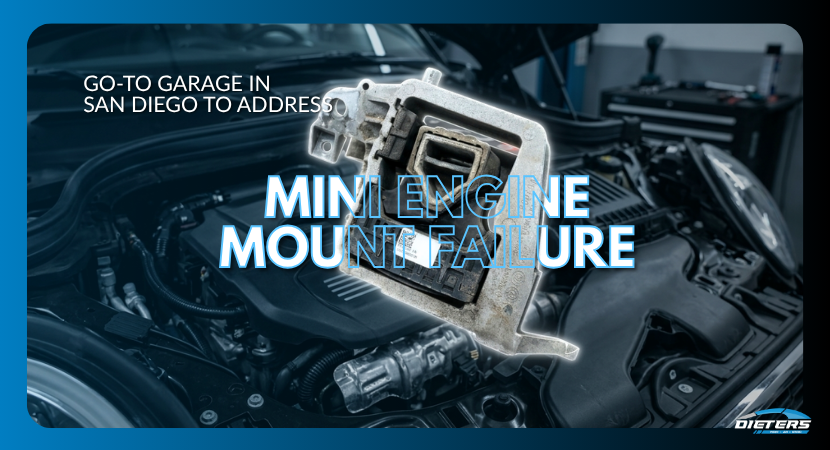
If your MINI Cooper is vibrating excessively at idle, clunking when you shift into drive or reverse, or shaking noticeably when you accelerate through San Diego‘s stop-and-go traffic on the 5 or the 163, failed engine mounts are one of the most likely culprits. Engine mount failure is a well-known issue on MINI’s R56, R55, R57, and F-series platforms — and because the symptoms mimic transmission problems, driveshaft issues, and suspension faults, it’s a repair that gets misdiagnosed regularly at shops that don’t specialize in MINI.
Dieter’s Porsche & BMW Service has been San Diego’s trusted independent European auto specialist since 1960 — one of the longest-standing European shops in Southern California. Our technicians work on MINI, Porsche, BMW, Mercedes, Audi, Volkswagen, and more from our Hancock Street location in San Diego’s Mission Hills neighborhood. If you’re searching for MINI engine mount repair near me in San Diego, here’s everything you need to know.
What Are MINI Engine Mounts and Why Do They Fail?
Engine mounts — also called motor mounts — are the rubber and metal brackets that secure your MINI’s engine to the chassis. Their job is twofold: they hold the engine in its correct position relative to the drivetrain, and they isolate engine vibration from the rest of the vehicle so occupants don’t feel every combustion event through the floorboards and steering wheel.
On MINI Cooper models, the engine is mounted transversely in a compact engine bay with tight clearances. The mounts are subjected to constant load from engine torque, especially on turbocharged Cooper S models, where torque output is significantly higher than on the base Cooper. Over time, the rubber element within the mount deteriorates — hardening, cracking, and eventually collapsing — which allows the engine to move excessively in its bay under load and at idle.
MINI uses both traditional solid rubber mounts and hydraulic mounts (filled with fluid for enhanced vibration damping), depending on the model and year. Hydraulic mounts fail due to fluid leakage when the internal membrane cracks, suddenly losing their damping ability and producing vibration that appears almost overnight.
Symptoms of MINI Engine Mount Failure San Diego Drivers Notice
San Diego MINI owners dealing with failed engine mounts typically describe a very specific set of symptoms that become more pronounced over time:
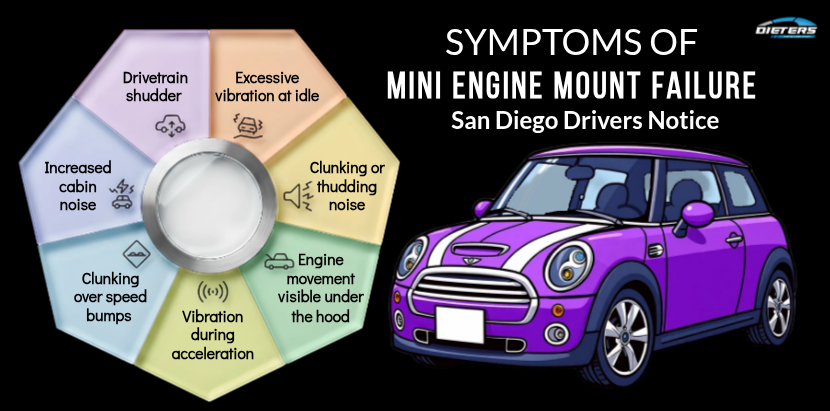
- Excessive vibration at idle — felt through the steering wheel, floorboard, and seat, particularly at stoplights and in drive-through lines
- Clunking or thudding noise when shifting from Park to Drive or Reverse — the engine lurches against its failing mount
- Engine movement visible under the hood — with the hood open and engine running, the engine visibly rocks more than it should during throttle blips
- Vibration during acceleration — particularly when pulling away from stoplights on University Avenue or Rosecrans Street
- Clunking over speed bumps — the engine shifts in its bay when the chassis flexes over road imperfections
- Increased cabin noise — more engine noise is transmitted into the cabin than normal, as the isolating rubber can no longer absorb vibration
- Drivetrain shudder — the excess engine movement puts stress on axle CV joints and can cause a shudder during low-speed acceleration
The symptom most MINI owners notice first is the clunk when engaging drive or reverse from a standstill — it’s dramatic enough to feel like a transmission problem, which sends many owners down an expensive and incorrect diagnostic path.
What Causes MINI Engine Mount Failure in San Diego
While engine mounts eventually wear on every vehicle, several factors specific to San Diego and MINI’s platform accelerate the failure:
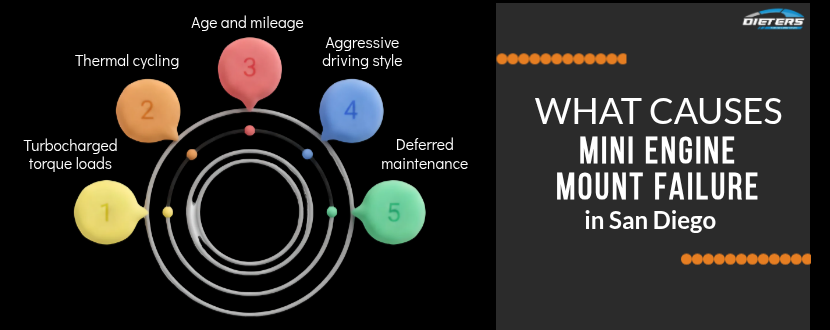
- Turbocharged torque loads — MINI Cooper S and John Cooper Works models produce significantly more torque than the base Cooper. The engine mounts on these variants absorb higher loads with every acceleration event, wearing faster than on naturally aspirated models. San Diego’s hilly terrain — Hillcrest, Mission Hills, and the grades heading into and out of Mission Valley — means frequent hard acceleration that repeatedly loads the mounts.
- Thermal cycling — San Diego’s warm climate keeps engine bay temperatures elevated year-round. The constant heat exposure accelerates rubber degradation in solid mounts and promotes membrane fatigue in hydraulic units. Unlike colder climates, where engines cool completely between drives, San Diego MINI engines frequently operate in sustained high-temperature conditions.
- Age and mileage — MINI R56 engine mounts commonly begin failing between 50,000 and 80,000 miles. Given that San Diego drivers often keep their MINIs for many years in the mild climate, high-mileage mount failure is extremely common at our Hancock Street shop.
- Aggressive driving style — MINI’s performance character invites spirited driving, and San Diego’s canyon roads through Balboa Park and Mission Trails Regional Park are popular with MINI enthusiasts. Hard launches and aggressive cornering place additional rotational load on the mounts, significantly accelerating their wear compared to gentle urban driving.
- Deferred maintenance — engine mounts are not on most MINI owners’ maintenance radar. Because the failure is gradual, many owners adapt to increasing vibration without recognizing it as a mount problem until the mount fails completely.
Why San Diego MINI Owners Shouldn’t Ignore Engine Mount Failure
Failed engine mounts create a chain of secondary damage that escalates repair costs rapidly:
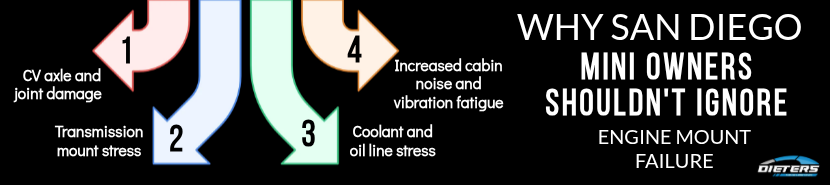
- CV axle and joint damage — excessive engine movement in the bay puts the constant velocity axles through angles they weren’t designed for, accelerating wear on the CV joints and boots. A CV joint failure on a MINI is a significantly more expensive repair than an engine mount replacement.
- Transmission mount stress — when the engine moves excessively, the transmission mount absorbs the excess movement. This accelerates transmission mount wear and can eventually damage the transmission case mounts themselves.
- Coolant and oil line stress — the hoses, lines, and wiring harnesses attached to the engine are designed to accommodate normal engine movement. Excessive movement from failed mounts stretches and fatigues these connections, potentially causing coolant, oil, or electrical leaks.
- Increased cabin noise and vibration fatigue — a MINI that vibrates excessively is simply unpleasant to drive. In San Diego’s heavy commute traffic — Mission Valley, the 8, the 5 — spending an hour a day in a vibrating car takes a real toll on driver comfort.
How Dieter’s Porsche & BMW Repairs MINI Engine Mount Failure in San Diego
Our technicians begin with a thorough inspection of all engine and transmission mounts — not just the one that’s most obviously failed. On MINIs with collapsed or leaking mounts, the remaining mounts have typically been absorbing additional load and are often not far behind. Replacing only one failed mount while leaving a compromised adjacent mount means returning to the shop within months for the same job.
We use quality OEM-specification replacement mounts and verify correct engine position and alignment after installation. On hydraulic mount-equipped MINIs, we inspect the associated vacuum lines and actuation system as part of the same service. Every repair is performed by technicians who work on MINI platforms alongside BMW, Porsche, and other European vehicles every day. For MINI engine repair and service in San Diego backed by over six decades of European auto expertise, Dieter’s is the shop San Diego MINI owners trust.
Why Choose Dieter’s Porsche & BMW for MINI Repair in San Diego, CA
Dieter’s Porsche & BMW Service has been a San Diego institution since 1960 — serving generations of European car owners from our Hancock Street location in Mission Hills. Our European engine repair specialists in San Diego bring platform-specific expertise to every job, with the diagnostic tooling and hands-on experience that MINI’s compact, turbocharged platforms demand.
We serve MINI owners across San Diego, Mission Hills, Mission Valley, Hillcrest, Ocean Beach, Point Loma, and throughout San Diego County. Open Monday through Friday, 8:00 am – 5:00 pm.
Frequently Asked Questions About MINI Engine Mount Repair in San Diego
How do I know if my MINI has a failed engine mount or a transmission problem?
Both can cause clunking when engaging drive or reverse and vibration during acceleration. The key distinction is that engine mount failure typically produces vibration at idle that worsens with load, while transmission issues usually present with shifting irregularities or slipping. A lift inspection at Dieter’s will identify the source definitively before any parts are ordered.
How much does a MINI engine mount replacement cost in San Diego?
Parts and labor for MINI engine mount replacement typically range from $300–$600 depending on which mounts require replacement and whether hydraulic or solid mounts are involved. Dieter’s provides a complete itemized estimate after inspection — no surprises.
Should I replace all MINI engine mounts at the same time?
On high-mileage MINIs where one mount has failed, inspecting and replacing all mounts simultaneously is often the most cost-effective approach — the labor to access the mounts is largely the same whether you replace one or all, and mounts that a failed neighbor has overloaded are typically close to failure themselves.
Does Dieter’s service all MINI models, including the Countryman and Clubman?
Yes. We service the full MINI lineup, such as the R50, R53, R56, R60 Countryman, R55 Clubman, F54, F55, F56, and F60 platforms — both naturally aspirated and turbocharged Cooper S and JCW variants.
Schedule Your MINI Engine Mount Inspection in San Diego Today
Don’t let a clunking, vibrating MINI turn into a CV axle or transmission mount repair. Dieter’s Porsche & BMW has been San Diego’s trusted European auto specialist since 1960 — and we’ll diagnose and fix it right. Call, schedule online, or visit us directly at 3375 Hancock St., San Diego, CA 92110!