

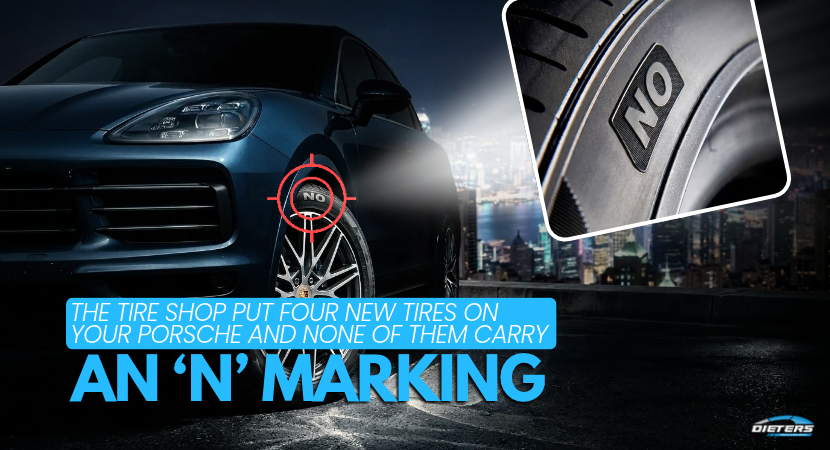
The car comes to us in San Diego a few weeks later with a complaint that is hard to pin down. The steering feels duller just off center, the back end moves around more than it used to over mid-corner bumps, and the owner is certain something in the suspension has gone wrong. Nothing has. The tires are the wrong ones, or more precisely, they are tires Porsche never developed for that car, and the difference shows up exactly where a Porsche is supposed to feel good.
What the N marking on a sidewall is
Look at the sidewall of an approved tire and you will find a small code near the size: N0, N1, N2, N3 and so on, sometimes with a zero that looks like the letter O. That marking means the tire was developed jointly with Porsche for a specific chassis and signed off against Porsche’s own test program.
The number marks a generation of the approval. N0 is the first approved version of that tire in that size, N1 the next revision, N2 after that. A higher number simply means a later revision. What matters is that the tire carries an approval at all, and that all four on the car carry the same one.
The approval covers more than grip. It covers the construction’s effect on steering response off center, the way the tire loads up progressively in a corner, high-speed stability, noise, and how the car’s stability control reads the tire’s behavior at the limit. Two tires of the same size, brand and speed rating can behave very differently in those areas.
Why the difference is noticeable on this car and not on others
A Porsche chassis is tuned tightly around a known tire. Spring rates, damper valving, bump steer, the rear axle’s compliance and the stability control calibration were all developed with one set of tire characteristics in the loop. Change the tire’s sidewall stiffness and you have changed an input to all of it.
On a crossover with soft suspension and slow steering, a different tire is a different tire. On a 911 or a Cayman it reads as a fault in the car, so the complaint usually arrives described as a suspension problem.
When a non-approved tire is a reasonable choice
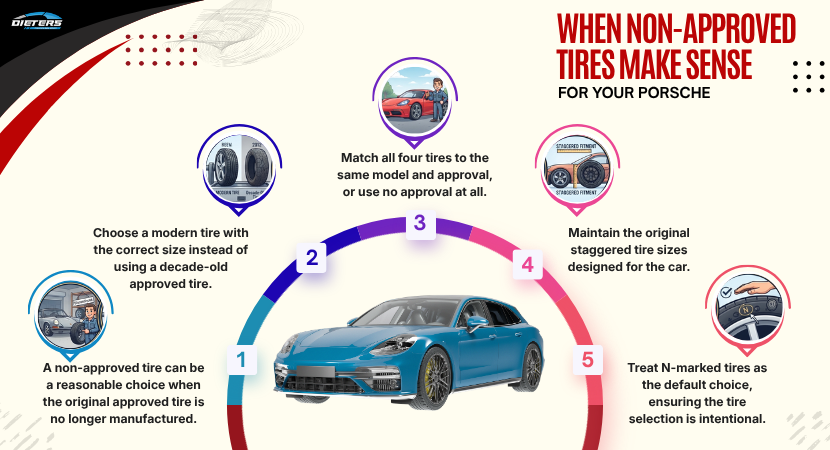
Not every situation calls for an approved tire, and anyone who tells you otherwise is selling tires. An older Porsche whose original approved tire is no longer manufactured in that size has to go somewhere, and a well-chosen modern tire of the correct size is usually better than a decade-old approved one.
Legally, the floor is low. The California DMV’s pre-drive safety checklist requires only that each tire have 1/32 inch of tread depth in any two adjacent grooves. That threshold decides whether a car may be on the road at all. It says nothing about whether a sports car still behaves the way it was designed to.
The rules that matter are simpler than the marketing suggests. Match all four corners to the same model and the same approval, or to no approval at all; never mix. Keep the staggered sizes the car came with. Treat an N-marked tire as the default, and if you go another way, make sure you chose it and the tire counter did not choose for you.
Age matters more than tread on a San Diego Porsche
Plenty of Porsches here cover four or five thousand miles a year. The tread lasts and the rubber does not. Find the four-digit date code at the end of the DOT number on the sidewall: the first two digits are the week, the last two the year. A tire from 2019 with 8/32 of tread left is an old tire wearing a young tire’s disguise.
Hardened rubber shows up first in the wet, which around here means the handful of genuinely wet days a year when nobody has adjusted their driving yet. It also shows up as a car that no longer settles into a corner the way it used to, which brings us back to the complaint at the top of this page.
Owners drive in from Point Loma, Coronado and Mission Valley for exactly this complaint, and the tires should be ruled in or out before anyone touches a damper.
Frequently Asked Questions
Q: Can I mix N0 and N1 tires on the same Porsche?
A: Not on the same axle, and we would not do it on the same car. They are different revisions of the construction, and the point of the approval is that all four behave as a set.
Q: Are N-rated tires more expensive?
A: Usually somewhat, and the gap is smaller than most owners expect once you compare like for like on a premium tire. The larger cost is fitting the wrong ones and chasing a handling complaint that no repair will fix.
Q: Does a non-approved tire affect Porsche stability control?
A: It can. The system is calibrated against known tire behavior at the limit, and a tire that breaks away differently changes when and how hard it intervenes.
Q: Where is the N marking on the tire?
A: On the sidewall, usually close to the size designation, in small raised lettering. If you cannot find it on any of the four, you do not have approved tires.
Read the Sidewalls Before You Chase a Damper
Bring the car in and we will read all four sidewalls, check the date codes and pressures, and road test it with you if the complaint is a feel instead of a noise. Dieter’s serves San Diego, Coronado, Mission Valley and Chula Vista as well as Point Loma.
Dieter’s Porsche & BMW Service, 3375 Hancock St, San Diego, CA 92110. More at dietersmotorsports.com.