

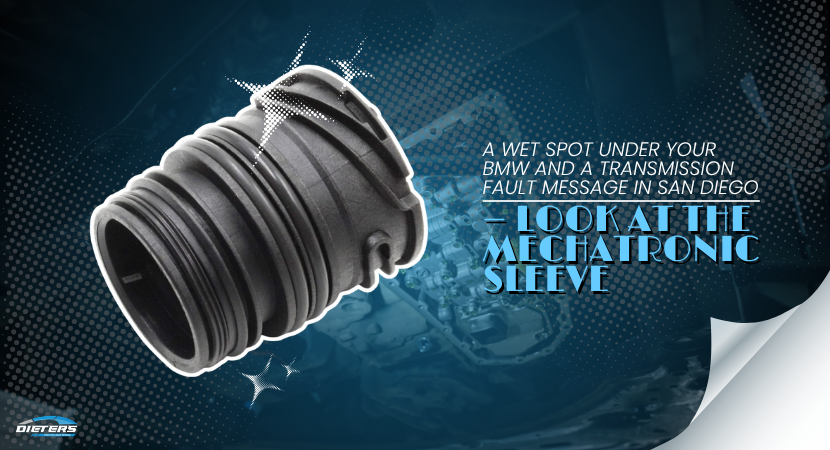
Two clues that belong together. A small reddish-brown puddle on the driveway near the middle of the car, and a message telling you to drive moderately or that a transmission fault has occurred. Most owners treat those as separate problems. On a BMW with a ZF six-speed automatic they usually are not — the mechatronic sleeve has hardened, transmission fluid is escaping, and the gearbox is running low.
We see it constantly on E90 and E60 cars and on the X5, and San Diego traffic is part of the reason. Over 60 years of European work at our Hancock Street shop has taught us the sequence: the leak comes first, the harsh shifts follow, and the warning message arrives last, once the level has dropped far enough to matter.
Quick Summary: Key Takeaways
- One part, two symptoms: A leak in the middle of the car plus rough shifting almost always means the mechatronic sleeve, not a failed gearbox.
- Low fluid does the damage: The gearbox does not tolerate a low level. Slipping, flaring and harsh engagement start well before the dash says anything.
- Not the same as the pan gasket: Fluid tracking from the electrical connector area on the side of the case is the sleeve. A wet pan rail is a different repair.
- Fill by temperature: These transmissions are filled to a specific fluid temperature, so it cannot be done properly without a scan tool watching the number.
- Warranty: Qualifying repairs carry our 24-month, 24,000-mile warranty.
The mechatronic sleeve is the seal between the gearbox and its wiring
Inside a ZF automatic, the valve body and its electronics sit in fluid, and the wiring has to get out of the case to reach the car. It does that through a sealed adapter — a sleeve pressed into the housing where the connector plugs in. Fluid is on one side, the wiring is on the other, and everything depends on a rubber seal that spends its life in hot oil. It hardens with age. Once it does, fluid pushes past under pressure.
Where the oil appears is the tell. High up on the side of the transmission, tracking down, dripping from the lowest point it reaches. Never from the pan rail.
Symptoms follow a predictable order once the level falls
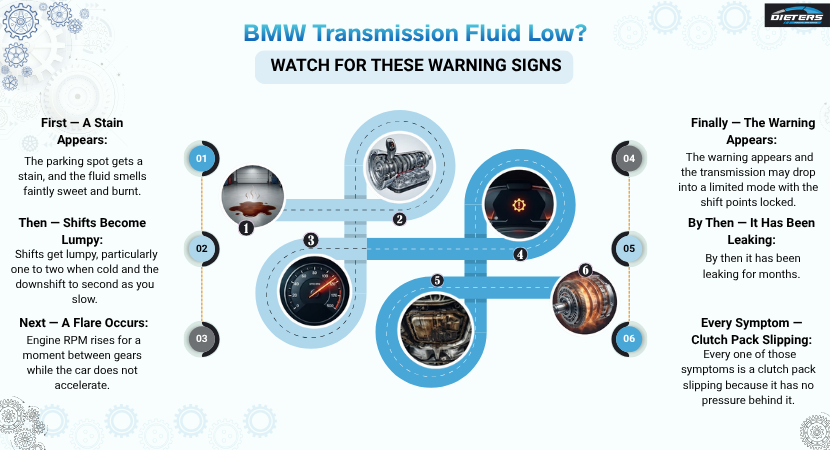
It goes in order. First the parking spot gets a stain, and the fluid smells faintly sweet and burnt. Then shifts get lumpy, particularly one to two when cold and the downshift to second as you slow. Next comes a flare — engine rpm rising for a moment between gears while the car does not accelerate. Finally the warning appears and the transmission may drop into a limited mode with the shift points locked.
By then it has been leaking for months. Every one of those symptoms is a clutch pack slipping because it has no pressure behind it.
Heat and stop-and-go traffic harden the seal early
The seal is a consumable. Heat sets its lifespan. Automatic transmission fluid runs hottest in slow traffic, where the torque converter slips constantly, and San Diego supplies plenty of that — the crawl on Interstate 8 through Mission Valley and the merge onto the 5 at Old Town do more damage to a gearbox than any freeway trip.
The Department of Energy’s figure for that kind of driving is blunt: aggressive stop-and-go driving can lower gas mileage by 10% to 40% in stop-and-go traffic. The fuel is what you notice. The fluid temperature is what quietly costs you the sleeve.
Driving on a low level is how a seal becomes a gearbox
Ignore it and the story gets much worse. Low fluid means aerated fluid, and aerated fluid cannot hold clutch packs together, so the packs slip and shed friction material into the valve body. That material sticks solenoids and blocks passages. The repair moves from a sleeve and a fill to a valve body, and from there to a rebuilt transmission.
There is an electrical risk on top of that. Fluid climbs the wiring by capillary action and can reach the control module, and a module that has been sitting in oil turns a sleeve job into something far larger.
How the repair is done properly on Hancock Street
The car goes on the lift and the leak gets traced to its highest wet point, because gravity drags oil across half the underside of a car and misleads people every single time. Stored transmission faults and adaptation values are read. The sleeve and connector seal are replaced with proper parts, the connector wiring is inspected for oil that has wicked up it, and the pan and filter are judged on what the old fluid looks like.
Then it gets filled the way ZF specifies: to level at a defined fluid temperature, with the scan tool watching, and the adaptations reset so the car relearns its shift pressures. Guessing at the level is how a fixed leak turns into a slipping transmission a month later.
Frequently Asked Questions
Q: What does a leaking mechatronic sleeve look like?
A: Reddish-brown fluid on the side of the transmission around the electrical connector, tracking down and dripping under the middle of the car. It is often mistaken for an engine oil leak, but transmission fluid is thinner, smells different and leaves a redder stain.
Q: Why does my BMW say transmission fault drive moderately?
A: The transmission control unit has detected pressures or slip values it cannot work with and has limited the gearbox to protect it. Low fluid from a leaking sleeve is one of the most common reasons on the ZF six-speed, and it is worth ruling out before anyone talks about a rebuild.
Q: Can you drive a BMW with a transmission fluid leak?
A: Only briefly, and only if you know the level is still adequate. Driving a low automatic transmission is what turns a seal repair into a clutch pack repair, so get the level and the leak checked within days rather than waiting for the next warning.
Q: Does a mechatronic sleeve replacement require removing the transmission?
A: No. The sleeve is accessible from outside the case with the transmission in the car on most models, and the job usually includes fresh fluid and a filter. A rebuild only enters the picture if the old fluid shows the clutch packs have already been damaged.
Get the leak traced before the gearbox pays for it
A stain on the driveway is the cheapest warning a BMW automatic ever gives you. Bring the car to our Hancock Street shop and we will trace it, read the stored faults and tell you exactly which repair you are looking at.
Hours: Monday to Friday, 8:00 AM to 5:00 PM. Closed Saturday and Sunday.
Website: dietersmotorsports.com