


You back out of the driveway in Point Loma, and there’s a small orange puddle where the Audi sat. On a warm San Diego morning, that’s often a cracked thermostat housing. Audi builds the housing and its coolant flange out of plastic, and years of heat cycling make it brittle until it splits at a seam.
Summer just speeds it up. A hairline crack that seeped a little in spring opens wider in July, and a slow drip becomes a real leak. Here’s how to catch it before your Audi overheats on I-8.
Quick Summary: Key Takeaways
- Plastic is the weak point: Audi thermostat housings and coolant flanges are plastic and crack with age and heat.
- Look for orange or pink coolant: A puddle or crust near the front of the engine is the classic sign.
- Overheating follows a leak: Lose enough coolant and the temperature climbs fast, risking the aluminum engine.
- It’s a common, fixable job: Housing replacement is routine when caught early – before it strands you.
- We back the work: Qualifying repairs carry our 24-month/24,000-mile warranty.
Audi Builds the Thermostat Housing From Plastic
The root of this problem is the material. To save weight and cost, Audi molds the thermostat housing and coolant flange in plastic, and those parts live in a spot that heat-cycles from cold to over 200 degrees thousands of times, which slowly makes the plastic brittle until it cracks at a seam or a bolt boss. San Diego summers push that timeline forward.
It’s not a defect you did anything to cause. It’s just what plastic does after years in the heat, and it’s one of the most common coolant leaks we fix on Audis.
The Leak Shows Up as Orange or Pink Coolant
Spotting it early is easy if you know the sign. Audi coolant is usually orange or pink, so look for a puddle under the front of the engine, a dried crust around the housing, or a low-coolant warning that keeps coming back. You may catch a sweet smell after a drive or see a little steam on a hot restart.
Find it at the drip stage, and the fix is straightforward. Wait, and you’re topping off coolant every few days until the day it runs dry at the wrong moment.
A Small Leak Becomes Overheating Fast
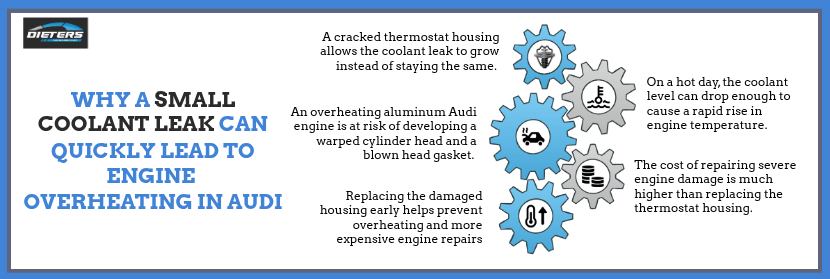
This is why we don’t tell people to wait and watch. Once the housing is cracked, the leak only grows, and on a hot day around Mission Valley, the coolant level can drop far enough to spike engine temperature before you even notice the gauge, which is when an aluminum Audi engine starts risking a warped head and a blown gasket. That repair dwarfs a housing job.
The math is simple. Replace a plastic housing on your schedule, or replace an engine after it overheats. One of those costs a lot more.
How We Diagnose and Fix It
We don’t guess at coolant leaks. We pressure-test the system to confirm the housing is the source and not a hose or the water pump, then replace it with the correct part and fresh Audi-spec coolant, and we bleed the system properly so you don’t get an air pocket that causes its own overheating. On many Audis we upgrade to the updated housing where one exists.
Most of these are a same-day or next-day job. You get a real diagnosis first, then a fixed price.

Why San Diego Audi Owners Come to Dieter’s
We’ve serviced European cars on Hancock St since 1960, and Audis are everyday work here. Owners from Coronado, Chula Vista, and Downtown bring us the leaks the dealer wants to charge a premium for. Our ASE-certified techs run factory-level diagnostics, and we back qualifying repairs with a 24-month/24,000-mile warranty.
Summer is coolant-leak season in San Diego. According to AAA, AAA expected to rescue 7.7 million drivers over the summer of 2025, and a dumped cooling system is a top reason drivers end up stranded. Catch the drip early.
Frequently Asked Questions
Q: What are the signs of a cracked Audi thermostat housing?
A: An orange or pink coolant puddle under the front of the engine, a dried coolant crust around the housing, a recurring low-coolant warning, and sometimes a sweet smell or light steam. The leak often starts small and grows, so an early drip is your cue to have it checked before it overheats.
Q: Can I drive my Audi with a leaking thermostat housing?
A: Only very cautiously and not far. A small leak can worsen quickly in summer heat, and running low on coolant risks overheating the engine. If the coolant light is on or you see a puddle, have it looked at before your next drive on I-8 or I-5.
Q: How much does an Audi thermostat housing replacement cost in San Diego?
A: It varies by model and engine, but housing replacement is a routine repair that costs far less than the engine damage overheating can cause. We pressure-test first to confirm the source, then give you a firm price before any work starts.
Q: Why do Audi thermostat housings fail in summer?
A: The housing is plastic, and years of heat cycling make it brittle until it cracks. Sustained summer heat both speeds that aging and widens an existing crack, so leaks that were minor in spring often turn serious during the hottest weeks of the year.
Stop the Coolant Leak Before It Overheats
Spotting orange coolant under the Audi? Bring it in and we’ll find the source before the heat finds your engine.
Dieter’s Porsche & BMW Service – 3375 Hancock St, San Diego, CA 92110
Hours: Monday-Friday, 8:00 AM – 5:00 PM
Website: dietersmotorsports.com